Indel AG
I learned in July 2016 that the company Indel AG (www.indel.ch) has built computer boards using Series 32000 microprocessors since the NS16032 came to market. Indel AG is located in Switzerland. Before using Series 32000 they made computers based on the first 16-bit processor PACE which was also developed by National Semicoductor. Obviously they like processors from National Semiconductor.
This information alone is not very exciting. But Indel AG is one of the rare companies which used Series 32000 and still exist today. And even better I could talk to people who have worked with Series 32000!
But what made me crazy was the fact that they still sell Series 32000 boards and get back boards from customers for repair in 2016 !!!
So what kind of application do they serve? There is only one possibility: industrial control. These computers are controlling machines which are expensive and live very long. It is no surprise that if a machine worth 100,000 Euro is standing still because a 1 Euro part of the computer is failing such a failure will be repaired. Most of the repairs are due to leaking batteries. The embedded computers of Indel AG use battery backup for saving data in memory. Sometimes a chip is not doing well after 20 and more years of continuous operation. Maybe there are still hundreds of machines out there controlled by Series 32000 microprocessors!
Indel AG used the first generation processors NS32016 and NS32032 and the embedded processors NS32CG16 and NS32FX16 for their products. The server orientated processors NS32332 and NS32532 were never used and there was no need for a memory management unit as well. But floating-point is important for industrial control and therefore they used the different FPUs. The special features of NS32CG16 and NS32FX16 were tested but not used.
Programming was done basically in assembler. Indel AG used a special macro assembler with a self defined language.
Once they had to bond the NS32202 ICU themselves because National Semiconductor could only deliver chips. This was at the End-of-Live (EoL) of this device. They never used devices from the second source partner Texas Instruments simply because they could not get them.
In 2015 Indel AG sent a lot of old stuff to a scrapyard. I will not think about what has been lost forever ... 🙁
In August 2011 Indel AG announced three new computer boards based on Series 32000 embedded processors:
- GCPU-15 : NS32CG16 CPU + NS32081 FPU, 15 MHz clock frequency
- GxCPU-15 : NS32CG16 CPU + NS32181 FPU, 15 MHz clock frequnency
- FxCPU-25 : NS32FX16 CPU + NS32181 FPU, 25 MHz clock frequency
The boards were built according to the Eurocard standard. The size of the PCB is 100 mm * 160 mm. All three boards used the NS32202 Interrupt Control Unit. An important feature is a main memory build of SRAMs with an on-board battery for backup.

Fig. 1. The first Series 32000 CPU board from Indel AG was designed in 1982. The FPU on the board shown here is a NS16000 family device.

Fig. 2. The GCPU-15 board. The empty 24-pin socket is used for the NS32081 FPU.
The GxCPU-15 and FxCPU-25 boards have an additional 96-pin connector. It is used for memory expansion. These boards are identical except for their CPUs which have different maximum clock speed. The four 20-pin PLDs of GCPU-15 are replaced by one 68-pin CPLD from Lattice. The CPUs NS32CG16 and NS32FX16 have basically the same pinout. The NS32FX16 contains an DSP processor which can work independently from the CPU. Indel AG did not use the DSP.

Fig. 3. One PCB for two products: the GxCPU-15 board on the left side and the FxCPU-25 board on the right side.
More technical facts about the three boards can be found in their datasheets. They are only available in german language.

Fig. 4. An ISA 16-bit board based on the NS32FX16 CPU.
A description of the operating system ISM is available. This OS is different from other operating systems like Unix because of the application area. Therefore it is interesting to read this document. The similarity to Series 32000 assembler syntax is remarkable. Again it is only available in german language.
I say "Thank you very much" to Indel AG for their great support in creation of this chapter!
Using the FxCPU-25
It is in 2026 nine years ago that I got the boards from Indel AG. Since then they were never in use. This changed
in September 2026 when I got an NS32181L FPU. I wanted to test this device and the FxCPU-25 board was the perfect
choice for it. I never worked with an NS32FX16 CPU and therefore this was a good chance to test the features of
the CPU.
The cpu boards of Indel AG have no peripherals like an UART on them. So I decided to connect the board to an old
FPGA board of mine. The FPGA board provides the UART and a small ROM for simple test programs. For the first tests
I used many cables to connect both boards, see Figure 5.
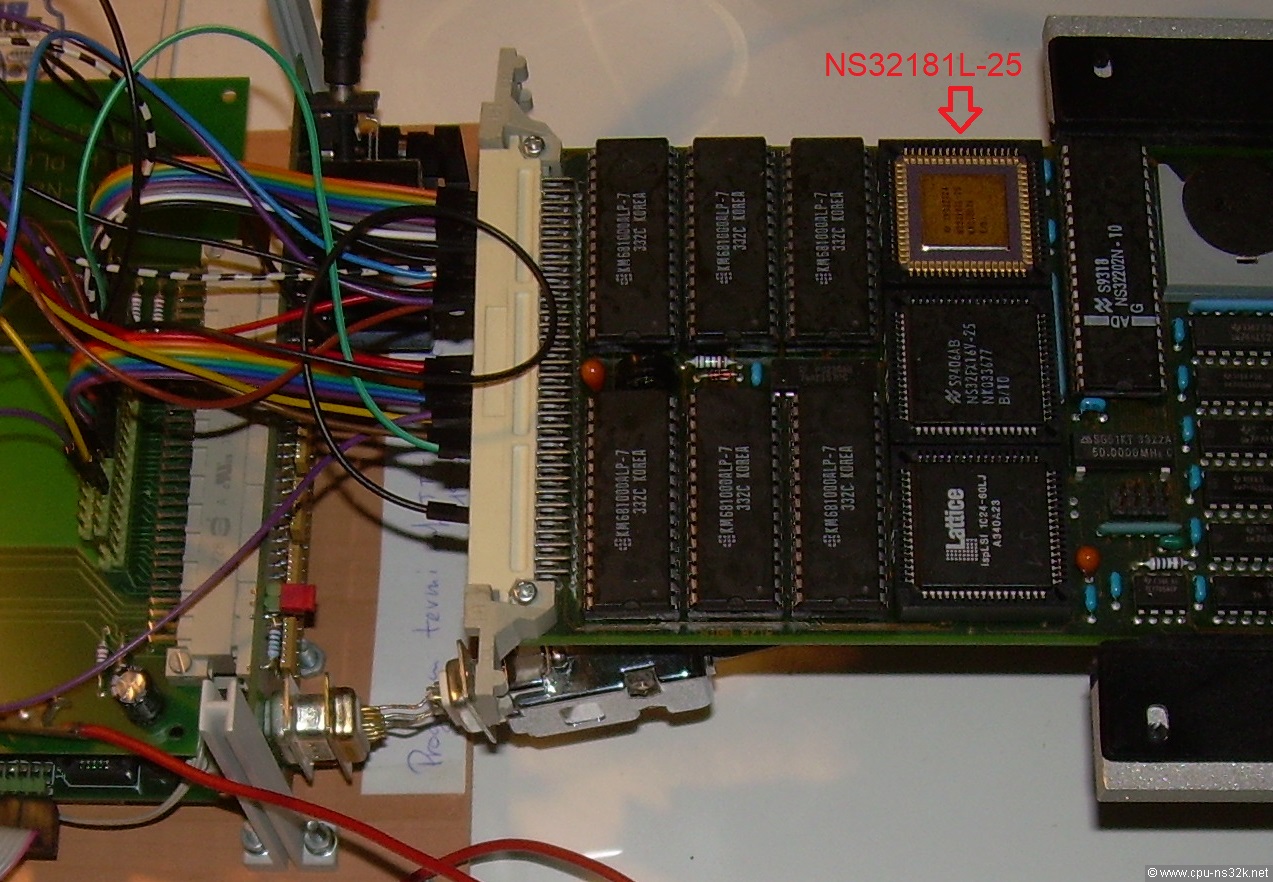
Fig. 5. The FxCPU-25 board connected to the old FPGA board on the left side with as many as 25 cables. 16
cables were already required for the data bus.
After the first successful tests I wanted a more professional solution for the connection of the two boards.
To design a simple pcb with two DIN connectors took not much time. Unfortunately I overlooked some characteristics
of the boards in use. The result was some rework of the small pcb after the first unsuccessful use of it.
During the tests some functions of the FxCPU-25 board were not clear to me. Luckily the contact person of 2017
at Indel AG is still working. He sent me some documentation which answered all my questions.
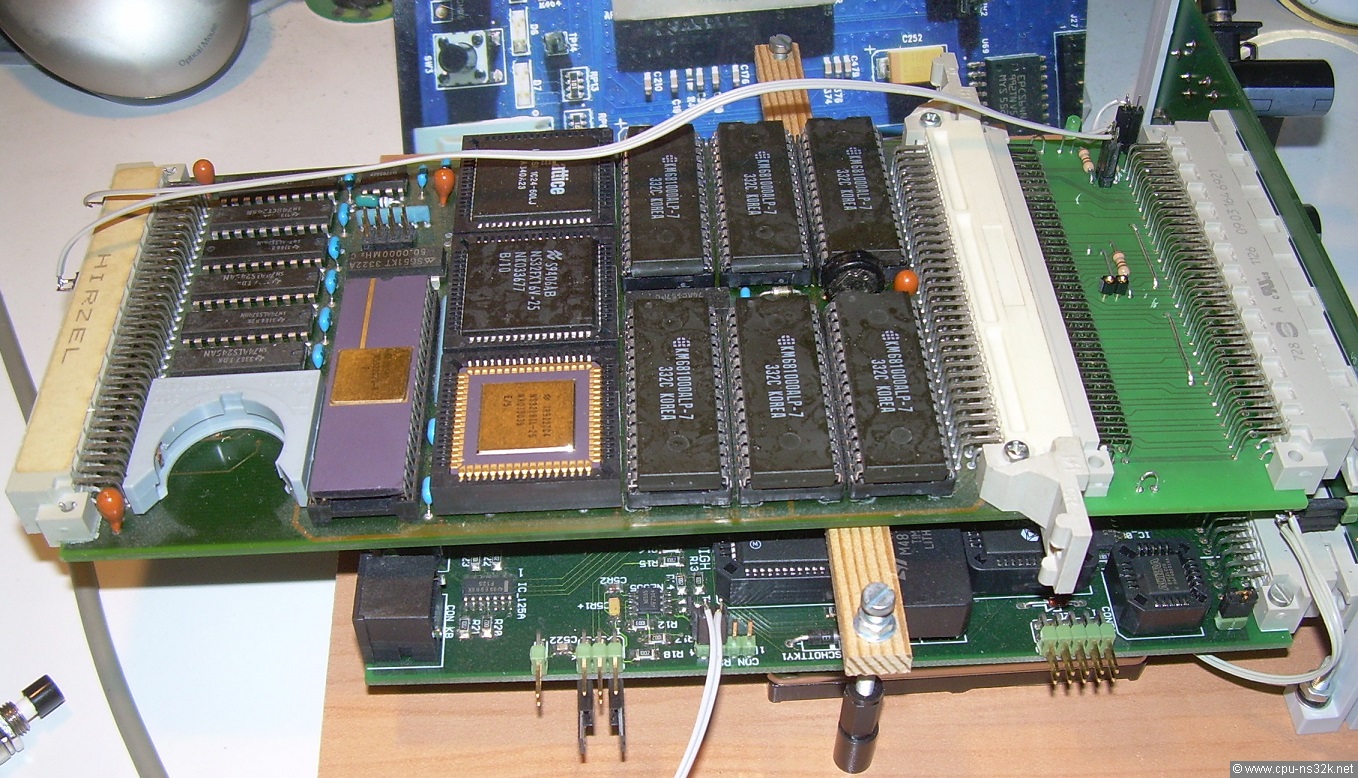
Fig. 6. Now the two boards have a solid connection. I exchanged the plastic packaged NS32202 ICU with the
ceramic version. It looks nicer 😊
The grey cable above the FxCPU-25 board connects the two interrupt outputs of the UART with the inputs of the
ICU. A third wire is used for reset.
The NS32FX16 CPU has an internal SRAM of 384 bytes. It can be used for program and data storage. There is no
speed advantage compared to external memory running without wait states. But it offers a lower power consumption.
A nice feature of all Indel AG boards is a backup battery for the memory. My board uses six CMOS SRAMs from
Samsung. The device KM681000ALP is a 1 Mbit low power type with a typical data retention current consumption of
just 2 µA at a supply voltage of 2 V.
To avoid any data loss during a battey change Indel AG added a supercapacitor of 0.22 F to the board. I was curious
to see how good this works. I took the battery out and measured the supply voltage of the SRAMs. Immediately after
power off it was 3.02 V. One hour later it was 2.48 V. Two hours later it was 2.35 V. This makes sense because the
leakage current becomes less when the voltage goes down.
The equation I = (ΔU/Δt) * C shows that the used current during the second hour is astonishing low:
only 8 µA . I would not expect this value for six old SRAMs together with an old supercapacitor and an old
board.
There is obviously enough time to change the battery...
This chapter was last modified on 5 November 2026. Next chapter: Janz AG